





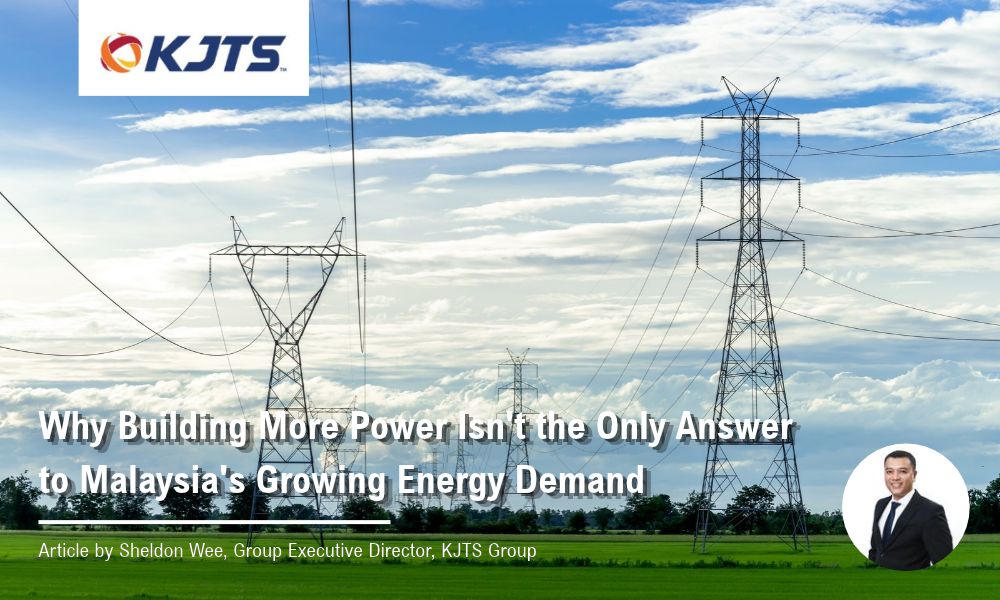
In our latest Thought Leadership series, our Group Executive Director, Sheldon Wee examines why improving energy efficiency is an important part of addressing Malaysia’s growing electricity demand.
The article explores the increasing pressure on Malaysia’s power infrastructure as electricity demand continues to rise. While investment in grid capacity remains important, including TNB’s RM15 billion grid investment, Sheldon highlights the need to consider how existing buildings and facilities can use energy more efficiently.
Sheldon explains why expanding power supply alone is not the only approach to meeting future energy needs. Improving the performance of existing cooling systems, reducing energy waste and optimising building operations can help businesses manage electricity consumption while supporting wider energy efficiency objectives.
The article also highlights KIP REIT malls, which achieved a verified 43% reduction in electricity consumption through KJTS Group’s cooling energy solutions. This demonstrates how targeted improvements to cooling infrastructure can deliver measurable energy savings and improve operational efficiency.
Through these practical insights, Sheldon emphasises the importance of combining infrastructure investment with energy efficiency measures. For building owners, facilities managers and business leaders, improving existing systems can be an important step towards managing energy costs and supporting Malaysia’s long term energy needs.
The article was first published on the KJTS Group LinkedIn page in 27 October 2026.
Malaysia will need more electricity in the years ahead. With new investments coming in, industries expanding and data centres being developed across the country, ensuring a reliable power supply has become increasingly important.
Budget 2027 recognises this, with Tenaga Nasional Berhad investing RM15 billion to strengthen the national grid.
This is an important investment. But I think there is another question we should be asking alongside it.
Are we making the best use of the electricity we already have?
In a lot of buildings, I don’t think we are.
Almost every conversation about Malaysia’s future electricity needs starts from the same assumption: demand will grow, so supply must grow to meet it. We debate how much capacity to build and how quickly the grid can be upgraded. Far less attention goes to the uncomfortable fact that a good share of the electricity we already generate is being wasted, much of it by buildings that have not been looked at properly in years.
Walk into a shopping mall or hospital with a 15-year-old cooling plant. The air is cold, the equipment runs and the bill gets paid. As far as the owner is concerned, nothing is wrong. Yet that plant may be using a great deal more electricity than it needs to, every hour, for years.
Multiply that across the country and we are, in effect, planning more power supply partly to cover that waste, not just to meet new needs.
We treat energy efficiency as a cost-saving exercise for building owners. Something nice to have if the payback works. I think that is a mistake. Every unit a building no longer needs is a unit that does not have to be generated or carried through the grid. That makes efficiency part of national energy planning, whether we choose to count it or not.
NEEAP 2.0 does put a number on it: a cumulative energy saving of 815,382 TJ and an 11.6% cut in national energy demand by 2035, against business as usual. That number rarely comes up when we discuss how much new supply the country needs.
The savings are not theoretical. At KJTS, we verified a 43% reduction in electricity consumption from cooling upgrades across eight shopping malls. My colleague Adrian Lim explains how that figure was measured in his article, “How do you know an energy saving is real?“ One portfolio will not change national demand. Results like that repeated across hundreds of buildings would start to.
New buildings are a bigger missed opportunity. A developer choosing a cooling system is often choosing on construction cost, because the developer does not pay the electricity bill for the next 20 years. Someone else does. The cheaper plant gets installed, and the building runs less efficiently than it should for its whole life. Fixing that later costs much more than getting it right the first time.
None of this means we should build less. Efficiency will not replace new generation, especially with energy-hungry industries arriving. But treating supply and efficiency as two separate conversations means we will almost certainly end up paying for more capacity than we need.
What we still need is a way to add up the results from completed projects so we know whether we are on track. Until we have those numbers, efficiency will keep being treated as a footnote to the supply debate.
The RM15 billion is the easy part. The harder question is whether we are prepared to take waste as seriously as we take growth. I would judge our energy planning by that, not just by how much new capacity we build.