





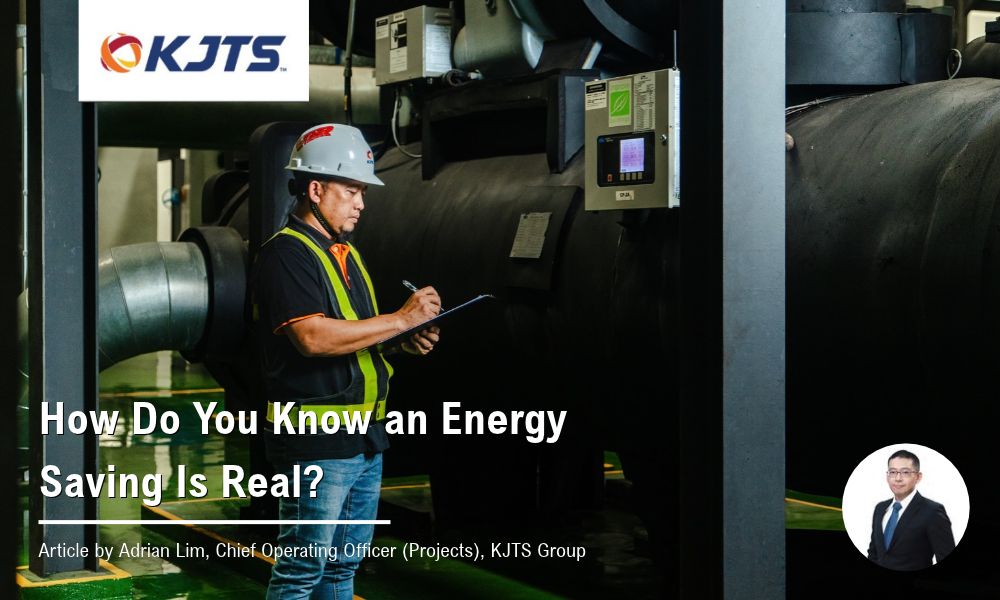
KJTS Group is sharing a LinkedIn article by Adrian Lim, our COO (Projects). The article explores how businesses can determine whether an energy upgrade is delivering genuine energy savings through proper measurement and verification (M&V).
It highlights the importance of looking beyond electricity bills. Changes in weather, occupancy, operating hours and cooling demand can affect energy consumption, making it essential to establish a reliable baseline and compare performance under comparable conditions.
The article covers baseline measurement, like-for-like comparisons, verified savings and the role of performance data in investment decisions. It also draws on KJTS’s experience across eight KIP REIT shopping malls and district cooling plant projects to illustrate how engineering assessments support energy performance evaluation and operational improvements.
Through these practical examples, Adrian shares insights into how measurement and verification can help businesses assess energy savings and make informed decisions about cooling energy investments.
*The article was first published on Adrian Lim’s LinkedIn profile on 18 October 2026.
When a company’s TNB bill drops after an upgrade, the natural assumption is that the new system is working. It might be. The bill alone won’t tell you.
Maybe it was a festive month and half the office was on leave over Hari Raya or Chinese New Year. Maybe there were more afternoon thunderstorms than usual and the chillers had an easier time. A floor might have been closed for renovation. Any of these will bring consumption down without the equipment becoming any more efficient.
It works the other way too. A system can be running better than it ever has while the total bill goes up, simply because the building is busier.
So when someone shows me a savings figure, my first questions are fairly basic. Compared with what? And what else changed in the meantime?
Answering those properly is the job of measurement and verification, which most of us in the industry just call M&V.
GET THE BASELINE RIGHT BEFORE ANYTHING IS TOUCHED
You can’t say how much an upgrade saved unless you know how the old system was performing. We call this the baseline, and it takes more thought than comparing it to last month’s bill.
The data has to cover a long enough stretch to show how the system normally runs. In Malaysia, that means the hot, dry spells as well as the wet ones, and the peak trading months as well as the quiet ones. For a cooling plant, we want to know how much electricity it used and how much cooling it delivered. We also want the operating logs that explain the conditions at the time.
We also need to agree on the boundary. Are we looking at one chiller, the whole chilled water system or the entire building? A saving measured on one chiller shouldn’t later be quoted as a saving for the building.
Before any work begins, we establish a baseline period, typically covering a full year, to capture normal weather and operating patterns. We also record the operating conditions needed to compare performance fairly after the retrofit. During energy audits, our work follows the standards stipulated under ASHRAE Guideline 22-2012.
This stage is easy to rush and very hard to fix later. Once the old equipment has been taken out, you can’t go back and measure it.
COMPARE LIKE FOR LIKE
Say a hotel replaces its chillers just before the school holidays end, and occupancy drops for the next few months. Electricity use drops too. Put the before and after bills side by side and the new chillers look better than they really are.
Or take a factory in Penang that adds a night shift after its upgrade. Consumption goes up, and on paper the new system looks like it isn’t delivering.
To keep the comparison fair, we adjust for whatever drives consumption at that site. Usually that’s weather, occupancy and operating hours, although it varies from project to project. The data has to support each adjustment. We can’t simply assume it.
What we’re really trying to work out is how much energy the old system would have used under today’s conditions. Measure the new system against that and you have an honest comparison.
A good example is our work across eight shopping malls under KIP REIT. The malls used a mix of water-cooled systems, water-cooled packaged units and air-cooled split units. To establish the baseline, we reviewed a full year of data, taking into account weather conditions, building cooling demand and typical operating hours. This allowed us to map the cooling load profile and develop the system design. After the retrofit, we monitored performance for 30 days. The data was collected jointly by the KJTS commissioning team and verified by the client’s technical representatives.
Across the eight malls, the verified reduction in electricity use was 43 per cent. That level of savings is guaranteed over the 20-year concession period.
Every adjustment should be written down. If the baseline has moved, the customer should be able to see why, and follow how we arrived at the final number.
A FORECAST ISN’T A RESULT
Before a project goes ahead, our engineers estimate the likely savings. They base it on the data available, the specifications of the new equipment and some assumptions about how the building will run.
That estimate is useful because it helps a business decide whether the project is worth pursuing. But it’s still a forecast.
A verified saving comes afterwards. It uses the method agreed at the start, real operating data and the adjustments I’ve described. The report should say plainly what was measured, what was assumed and what period it covers. One good month doesn’t prove a good year, especially in a country where the weather can change so much between monsoon seasons.
It’s also worth keeping energy and money apart. Because of the way TNB structures its tariffs and charges, a 20 per cent cut in energy use won’t necessarily mean a 20 per cent cut in your bill. If you’re working out your return on investment, you need to know which of the two you’re looking at.
WHAT THE NUMBERS ARE FOR
For me, verification doesn’t end at handover. It’s part of looking after the investment.
When savings come in below expectations, the customer deserves an explanation. Sometimes it’s a control setting. Sometimes it’s a maintenance issue, or an assumption that stopped holding once the building began to be used differently. Either way, the facilities team has something specific to look into.
At a district cooling plant in the Klang Valley, our review identified several value engineering opportunities. The client adopted them, achieving significant capital and operating cost savings, and later applied the same improvements to its other district cooling plants.
In another case, a client had little visibility into its chiller plant’s efficiency because the building management system was no longer operating. Our energy audit showed that the plant was performing well below ASHRAE Standard 90.1. With clear evidence of the problem, the client quickly appointed KJTS to carry out a Retrofit-Operate-Transfer (ROT) exercise. The upgraded system delivered efficiency gains that helped recover the project’s capital cost quickly.
Good data also makes the next decision easier. If the finance team is weighing up a second upgrade, they’ll want proof that the first one delivered. And with more Malaysian companies reporting on energy use and emissions, including listed companies under Bursa’s sustainability requirements, the figures need to hold up when someone asks how they were worked out.
The engineering behind M&V can get quite detailed. That’s our job to deal with, not the customer’s. What we hand over should be clear enough for someone without an engineering background to follow.
If a business tells me it has cut its energy use by 20 per cent, I’ll want to know three things. Twenty per cent compared with what, over what period, and measured how? If those answers are there, I’m happy to take the number seriously.