




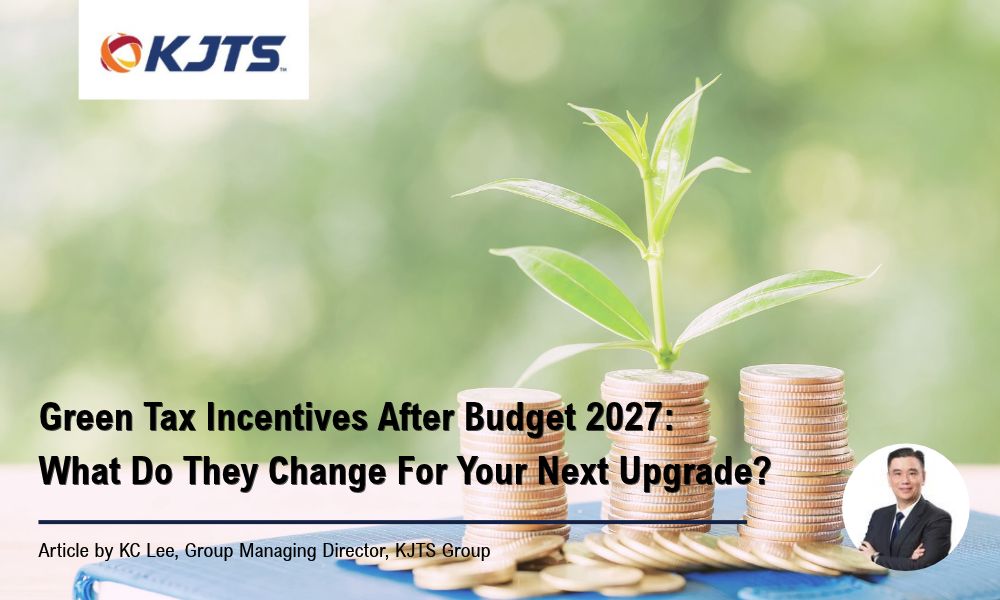
KJTS Group is sharing another LinkedIn article in our Thought Leadership series. In this latest article, KC Lee, Group Managing Director of KJTS Group, examines how green tax incentives following Budget 2027 could affect businesses planning their next cooling plant upgrade.
The article explains the extension of green technology tax incentives until 31 December 2030 and the importance of understanding the applicable allowance rates and eligibility criteria. KC highlights why a tax allowance should not be treated as a cash grant, and how the actual tax benefit can differ from the headline allowance.
The article covers three key considerations for businesses planning an upgrade. These include equipment eligibility, asset ownership and the financial implications of tax relief. It also explains how to assess cash flow, payback periods and the timing of tax savings alongside energy cost reductions and ongoing maintenance expenses.
KC further emphasises the importance of integrating engineering assessments with financial and tax planning from the outset. By evaluating equipment performance, documenting qualifying expenditure and confirming eligibility early, businesses can develop a more informed investment case for cooling plant upgrades.
Through these practical insights, KC highlights the need for building owners, facilities teams and finance leaders to work together when evaluating energy efficiency investments and making long-term capital decisions.
The article was first published on the KJTS Group LinkedIn page on 22 October 2026.
Whenever I sit down with building owners to discuss a cooling plant upgrade, the conversation almost always starts with two things: the upfront capital cost and the expected energy savings. Very rarely does anyone bring the tax position into that first meeting.
That is usually a missed opportunity.
Our chiller plant refurbishment at Sri Kota Specialist Medical Centre gives businesses a practical reason to look closer at this. Earlier this year, the hospital secured RM2.7 million in approved Green Investment Tax Allowance (GITA) incentives through the project.
For any leadership team thinking about an upgrade, an approved incentive deserves a place on the table right alongside kilowatt-hour reductions. It directly affects your payback period and helps a project compete against other demands for capital.
At the same time, an allowance is not a cash grant. A headline percentage in a Budget announcement can look very different from the actual cash benefit that ends up on your balance sheet.
Following the announcements in Budget 2027, here is how I would evaluate what changes for your next investment.
What the extension means for an upgrade
Budget 2027 announced the extension of green technology tax incentives until 31 December 2030, with investment tax allowances of up to 100%. The headline sounds generous, but the scheme is now more targeted, and the rate and eligibility depend on the specific asset.
For companies purchasing equipment for their own operations, GITA Asset for Own Consumption is the natural starting point. Under the published 2024–2026 guidelines, qualifying energy-efficiency equipment can include chillers, cooling towers, air compressors, and heat recovery systems. The category carries a 60% allowance, set off against 70% of statutory income.
However, under the Budget 2027 proposals, energy efficiency drops off the list of qualifying assets for own use from 2027, subject to the Finance Bill. For a chiller upgrade, that makes the current window, which covers qualifying expenditure up to 31 December 2026, more important. Either way, eligibility needs to be confirmed before any tax benefit is banked into an approved business case. Sri Kota’s approval was secured under the current guidelines; it shows what is possible, but it should not be taken as an automatic guarantee that another project will receive identical treatment.
That does not mean putting project planning on hold. What it does mean is doing the groundwork early:
- Review the equipment schedule together: Have your engineering team, facility managers, and tax advisers look at the quotation line by line. Which specific assets qualify? How much of the total quotation relates directly to those assets, and what supporting technical data will be required?
- Clarify asset ownership before signing: Under current rules, qualifying assets must be new, owned by the applicant, and used for its own operations in Malaysia, meeting MGTC verification and MyHIJAU criteria. If you partner with an energy service company that funds and owns the plant, you cannot simply assume the allowance belongs in your own tax calculation. Decide who holds the asset on their books right at the start.
The number that matters to finance
A percentage in a Budget speech can sound far more generous than the reality of corporate tax computations.
Consider a simple illustration: RM1 million of qualifying expenditure at a 60% allowance rate produces an investment tax allowance of RM600,000. Assuming a standard 24% corporate tax rate and enough eligible statutory income to absorb it fully, the actual tax saving is RM144,000.
A RM144,000 bottom-line saving can certainly strengthen an investment case. But it is very different from having RM600,000 in cash available to pay the equipment supplier.
Timing is where many financial models fall down. Contractors and equipment manufacturers must be paid according to project milestones during installation. The tax benefit, by contrast, only materialises later when corporate tax returns are filed and assessed, often spread over multiple assessment years depending on statutory income limits.
I want to see that timing reflected clearly in the investment proposal. Matching cash outlays against the timing of tax relief and energy savings shows whether a business can comfortably fund the transition.
It also forces an honest distinction: does this project make commercial sense on energy savings alone, or does the business case collapse without tax relief? Both types of projects may be worth doing, but the second demands far greater certainty on tax approval before committing capital.
And there is another number finance should run side by side: the cost of doing nothing. Deferring an upgrade avoids a capital outlay this quarter, but an inefficient plant keeps leaking cash through higher utility bills, emergency repairs, and maintenance downtime every single month. Those running losses belong in your financial model just as much as potential tax savings.
Build the application as you plan the engineering
Thinking about incentives early does not mean submitting paperwork before the equipment is even ordered.
Under current GITA Asset guidelines, formal verification applications are made after commissioning, generally within 24 months of incurring qualifying expenditure. Any project that runs past 31 December 2026 needs its position checked with MGTC.
What you can do right now is build the documentation audit trail alongside your engineering drawings, rather than scrambling after the plant is switched on:
- Keep equipment performance datasheets, MyHIJAU certifications, purchase contracts, and commissioning logs in a single project file.
- Assign clear ownership across teams: facilities provides the operating and efficiency data; finance and tax handle the submission timelines.
- Keep the engineering assessment rigorous. A high-efficiency chiller will only deliver its rated performance if the cooling towers, pumps, and system controls are properly integrated.
Leaving documentation until months after handover makes resolving missing technical data or unexpected eligibility gaps twice as difficult.
Bringing the plant room and the boardroom together
Sri Kota proved that substantial incentives are achievable when an upgrade is structured properly from an engineering and tax standpoint.
If your facility is due for a cooling overhaul, do not let engineering and finance plan in silos. Bring your facilities director, CFO, and tax adviser around the same table while the proposal is still taking shape.
Before the project goes to the board for approval, management should know three things with absolute clarity: what the plant mechanically needs, what the investment will save on monthly utility bills, and how much of that return actually depends on tax relief.