





KJTS Group is sharing another LinkedIn article in our Thought Leadership series. In this latest article, KC Lee, Group Managing Director of KJTS Group, reflects on how the Group has evolved from managing cooling plants to taking a broader approach to integrated energy management.
The article explores how KJTS’s experience in cooling energy solutions, long-term performance contracts and energy monitoring has shaped its development. KC highlights how the Group’s acquisition of iHandal has expanded its capabilities into heat recovery, allowing businesses to address energy consumption beyond cooling systems.
KC explains how cooling energy management and heat recovery can complement each other. Both require strong engineering expertise, measurable performance and a focus on long-term value.
Through these insights, KC highlights how KJTS is applying its experience in energy management to a wider range of building and industrial operations, supporting businesses in improving energy performance and making more informed decisions.
The article was first published on KC’s LinkedIn page on 10 November 2026.
For most of my career, success in our business has been measured by one question: how little electricity does it take to remove the heat from a building? It is a good question, and it is the number we put in front of our customers every month. But for a long time, we did not spend much time on a second question: where does that heat go?
I have been thinking about that second question a lot recently, because it explains how KJTS has grown. So rather than look at one topic in detail, I want to step back and explain how our work has moved on since I first looked after one shopping mall’s cooling plant.
WHERE I STARTED
In 2003, I was put in charge of operations and maintenance at a shopping mall in the Klang Valley, which was our first energy performance contract. What I learnt there has shaped how we work ever since. When you are responsible for a cooling plant over many years, you cannot hide behind the specifications on a brochure. Either the plant performs, month after month, or it does not, and if it does not, it is your problem to fix.
That experience is still at the centre of the business. In many of our contracts, we upgrade or build the cooling plant, operate it for the contract period, and hand it over to the building owner at the end. Customers pay through a monthly charge instead of a large upfront investment, and because we are tied to the plant for 10 or 20 years, we have every reason to keep it running well. Cooling remains our core business, accounting for close to four-fifths of the Group’s revenue in the second quarter of this year.
FROM RUNNING PLANTS TO MANAGING ENERGY
Long contracts change the way you think. Once you have guaranteed a level of savings for 20 years, you need to know, with real confidence, that you are delivering it. That is where much of our energy-management work comes from. Over time, we built up the measurement, monitoring and verification behind our numbers, as Adrian Lim explained in his article on whether an energy saving is real. Across eight shopping malls owned by a listed retail REIT, that work verified a 43% reduction in electricity use.
We also had to understand more than the plant. Tariff structures, peak pricing and tax incentives all affect what a customer actually saves, and my colleagues and I have written about several of them. A cooling contractor can afford to stop at the plant room door. An energy service company cannot.
Along the way, KJTS listed on the ACE Market of Bursa Malaysia in January 2024, and took the same model to Thailand through KJTN Engineering, where we now run cooling contracts for hotels.
WHAT iHANDAL ADDS
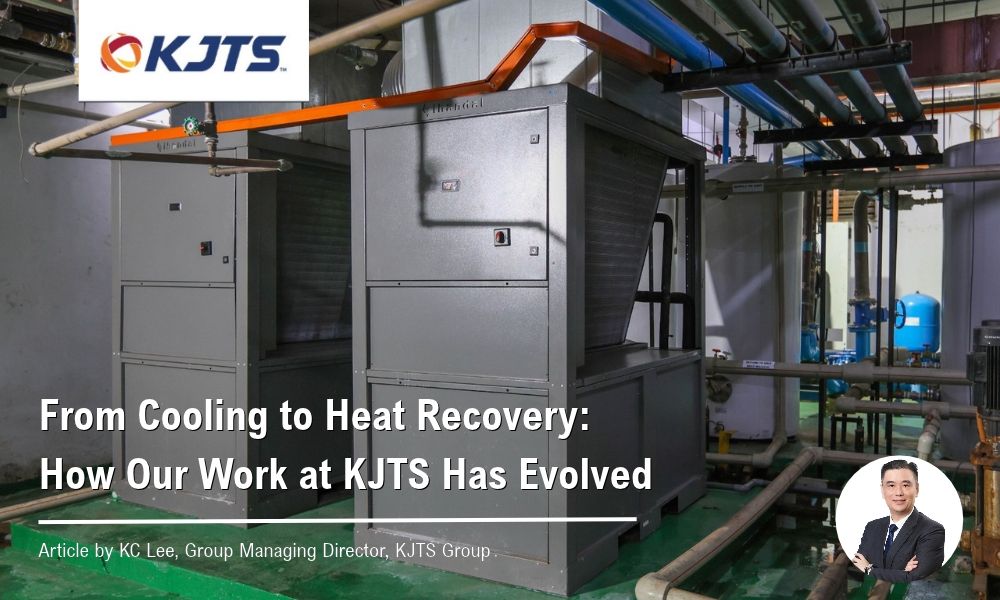
In April this year, KJTS completed the acquisition of a 70.67% stake in iHandal, which has been working in heat recovery since 2009. Its systems have been installed in more than 200 properties across Asia Pacific, and it serves both hospitality and manufacturing. iHandal has signed 10-year savings-sharing agreements with three Top Glove subsidiaries in Selangor, most recently in June, to recover waste heat from their processes and turn it into hot water for manufacturing.
The way those agreements work will sound familiar. The customer does not pay a large sum upfront, and the savings are measured and shared. It is the same basic thinking behind our cooling contracts, applied to heat. What iHandal brings is a different set of engineering skills, and access to customers whose biggest energy cost may not be cooling at all. A glove factory or a hotel laundry spends a great deal on producing heat, and until now, that was largely outside our reach.
WHY COOLING AND HEAT BELONG IN THE SAME CONVERSATION
Here is something that is obvious to an engineer but rarely discussed in a boardroom. A cooling plant does not destroy heat; it moves it. It takes heat out of a building and, in most cases, releases it into the air through cooling towers.
Meanwhile, many of the same buildings are paying to create heat. A hotel needs hot water for its rooms, kitchens and laundry, and a factory may need it for cleaning or production. In some cases, one part of a building is spending money to get rid of heat while another part spends money to make it.
That does not mean every site is an opportunity. As Aaron Patel pointed out in his article on data centre heat, the heat has to be at a useful temperature, available when it is needed and close enough to the user to be worth moving. Those conditions do not always line up, and when they do not, we should say so. But the question is now part of how we look at a building. When we assess a cooling plant, we can also ask whether the heat it rejects, or the heat a building generates elsewhere, has a use.
HOW IT FITS TOGETHER
The Group today covers cooling energy, facilities management and, through iHandal, heat recovery, across Malaysia, Singapore and Thailand. What ties them together is not a single product but the way we work. We take responsibility for performance over the long-term, we measure what we deliver, and we get paid in a way that is linked to results. That applies whether we are running a chiller plant in a shopping mall or recovering heat in a glove factory.
We are a cooling company that has learnt to think about energy more broadly, and that has not changed our focus on the plant room. If anything, it has made us more careful about it. When I think back to that first contract in 2003, the core job looks very much the same: keep the building comfortable, use as little energy as possible doing it, and be able to prove it. What has changed is how far we can look for savings once that job is done.