




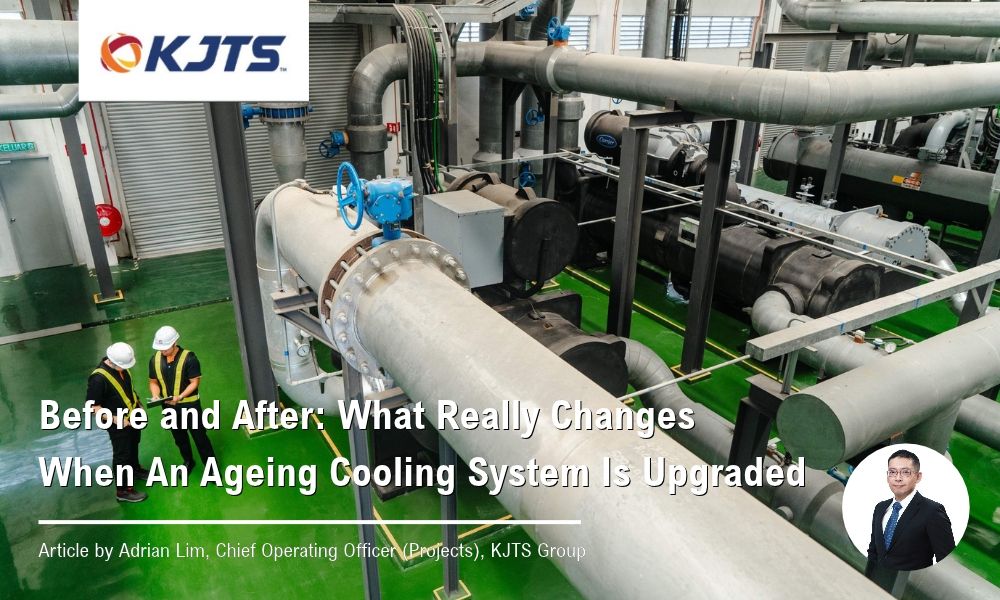
KJTS Group is sharing another LinkedIn article in our Thought Leadership series. In this latest article, Adrian Lim examines what really changes when an ageing cooling system is upgraded, using a client case to highlight the importance of understanding plant performance before making major investment decisions.
The article explains how a building can continue to operate comfortably while its cooling plant uses more electricity than necessary. With the building management system no longer working, the client had limited visibility of the plant’s efficiency and the information needed to assess whether an upgrade was justified.
Adrian highlights how an energy audit helped establish the plant’s performance against ASHRAE Standard 90.1 and identify areas for improvement. The assessment supported the client’s decision to appoint KJTS under a Retrofit Operate Transfer arrangement, covering the plant upgrade, operation and eventual transfer back to the owner.
The article also examines why equipment replacement alone may not deliver the expected results. Chiller sequencing, control settings, maintenance and changing building requirements all influence ongoing energy performance. Adrian emphasises the need to consider these operational factors alongside capital costs, repair expenses and the long-term cost of maintaining ageing equipment.
Through this practical case, Adrian highlights the importance of using reliable performance data to guide investment decisions. For building owners and facilities teams, understanding how an existing plant operates is an important first step towards identifying the right improvements and achieving better operational and financial outcomes.
The article was first published on the KJTS Group LinkedIn page on 4 November 2026.
If a building is comfortable and nobody is complaining about the air conditioning, replacing the cooling equipment is a hard investment to justify. The system still works. The facilities team knows how to handle it. And there are other requests waiting for budget. The harder question is whether the owner knows what it costs to keep it working that way.
In my earlier article on measuring energy savings, I mentioned a client whose building management system had stopped operating. That case is worth coming back to, because it shows how an upgrade decision changes once the owner can see what the plant is really doing.
WHEN “STILL WORKING” DOESN’T TELL YOU THE FULL STORY
At that client’s building, the cooling plant was running, but the client had very little visibility of how efficiently it was running.
Its building management system, or BMS, was no longer working. That’s the system the facilities team uses to monitor and control building services, including the chillers. Without it, there was no reliable way to tell whether the electricity going in was reasonable for the cooling coming out.
That’s an awkward place for a building owner to be. You may suspect the plant is costing too much to run, but a suspicion won’t get a major investment approved. And carrying on with repairs doesn’t tell you whether keeping the old equipment is the better choice either.
The facilities team is in the same position. A good operator can tell you a lot about a plant: which chiller trips on a hot afternoon, which pump sounds wrong, what to switch on first thing on a Monday. That knowledge is valuable. But it can’t put a reliable number on efficiency.
Here in Malaysia, that gap matters more than people think. We don’t get a winter break. A cooling plant in KL runs every day of the year, often for 12 hours or more. So if it’s using more electricity than it should, that waste is happening every day, all year, for as long as nobody measures it.
GIVE MANAGEMENT SOMETHING IT CAN ACT ON
Our energy audit established that the plant was performing well below ASHRAE Standard 90.1 and showed where it could be improved.
That gave the client something solid to decide on. Following the assessment, it appointed KJTS under a Retrofit-Operate-Transfer arrangement. We upgrade the plant, operate it for an agreed period and then transfer it back to the owner.
To me, that’s what an audit is for. It should help the owner make a decision, not just produce a report that sits unread in a pile.
Does the plant need a major upgrade, or would targeted repairs do the job? Are the operating practices part of the problem? The answer should come from looking properly at the system, not from assuming that everything old needs replacing.
Age does change the maths, though. Some older chillers still run on refrigerants such as R-22, which Malaysia aims to phase out completely by 2030 under the Montreal Protocol. Parts for older models also get harder to find. So the cost of keeping old equipment going tends to rise over time, even if the plant itself hasn’t changed. That should be considered in the decision making process too.
And the reverse is true. A new chiller may look more efficient on paper, but we still need to understand how it will work with the rest of the plant and the building’s actual cooling needs. Get that wrong, and the owner can spend a lot of money and still be left with some of the same problems.
INSTALLATION IS ONLY PART OF THE JOB
Because we operate the plant after the retrofit, the day-to-day decisions are part of the result. Which chillers should run as the load changes through the day? Are the controls responding properly? When performance drops, how quickly does someone find out why?
New equipment doesn’t make those questions go away. A setting gets changed to deal with a problem one afternoon and is never put back. A sensor starts giving bad readings. A tenant moves out, or the building’s hours change, and the plant keeps running on its old schedule.
None of this will necessarily cause a cooling complaint. Nobody rings the facilities office to say the chillers are wasting electricity. But all of it affects how much power it takes to keep the building comfortable.
That’s why I’d look closely at the operating arrangements in any upgrade proposal. Someone has to be responsible for checking that the expected performance is being maintained, and for doing something when it isn’t.
WHAT CHANGED FOR THE CLIENT
In this case, the upgraded system delivered efficiency gains that helped recover the project’s capital cost quickly. The client went from having very little information about an underperforming plant to an investment with a clear operational and financial return.
The point I’d take from it is that keeping old equipment is never free. You pay for the extra electricity every month. You pay for the maintenance. And your facilities team pays in time spent keeping an ageing plant reliable. Those costs don’t show up on a capital budget, which is exactly why they’re easy to ignore.
They need to sit alongside the cost of replacement. An upgrade won’t always win that comparison. But “the equipment still works” is where the assessment should start, not where it ends.
BEFORE YOU APPROVE ANOTHER REPAIR
I’d ask the facilities team two questions. Do we know how efficiently the plant is running? And do we have enough reliable information to decide whether the next repair is worth doing? If the answers are vague, start there.
Then look past the installation proposal. Ask who will operate the upgraded system, how its performance will be checked and what happens if the savings fall short.
In my earlier article, “How do you know an energy saving is real?“, I explained how we establish whether an improvement has actually been achieved.
For an owner thinking about an upgrade, that work starts before anything is replaced. The better you understand the plant you already have, the better your chances of spending on the right things.