





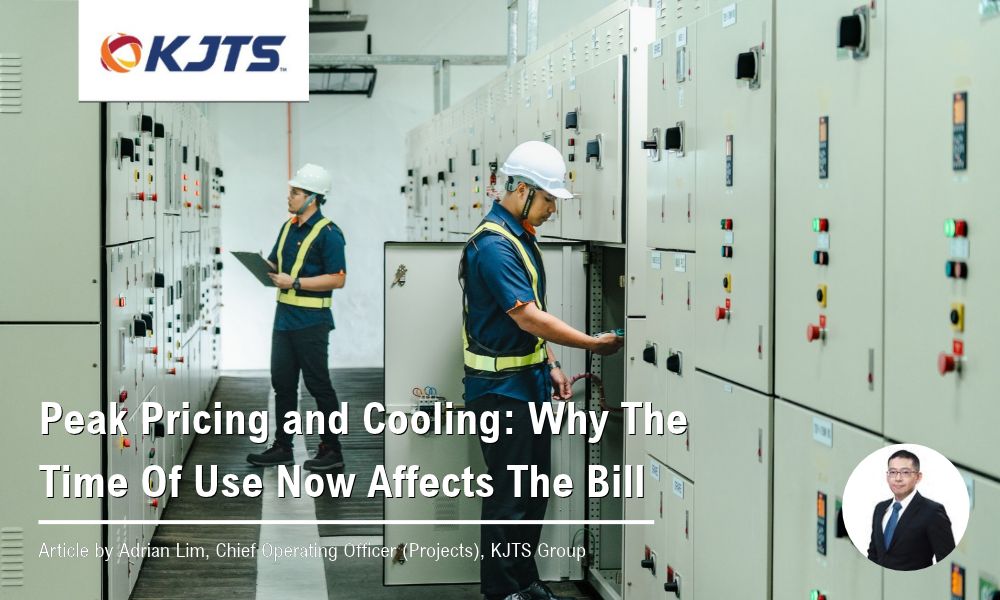
The article explains how the tariff structure introduced by Tenaga Nasional Berhad on 1 July 2025 has changed the peak and off peak periods for time of use customers. Adrian highlights why the difference in electricity rates per kWh is only part of the picture, with peak period demand charges having a significant impact on monthly electricity bills.
The article explores practical ways to manage cooling demand during peak hours. These include optimising chiller sequencing, managing plant restarts, using pre cooling strategies and reviewing thermal energy storage options. Adrian explains why shifting cooling loads can be challenging in Malaysia’s climate and why thermal storage investments need to be assessed based on site conditions and maximum demand charges.
Adrian further emphasises the importance of monitoring half hourly electricity consumption data to identify when maximum demand occurs and what drives the peak. By reviewing operating schedules, control settings and changes in building loads, facilities teams can identify opportunities to improve plant performance before committing to major capital expenditure.
Through these practical insights, Adrian highlights the importance of understanding both when and how buildings consume electricity. For building owners, facilities managers and energy decision makers, managing peak demand is an important consideration in controlling energy costs and planning cooling system improvements.
The article was first published on the KJTS Group LinkedIn page on 29 October 2026.
One hot afternoon can set a building’s demand charge for the entire month. Ask most building owners which afternoon it was, and they won’t know. That didn’t matter so much before. It does now.
Since TNB’s new tariff structure took effect on 1 July 2025, the peak period for time-of-use customers runs from 2pm to 10pm on weekdays. The rest of the week is off-peak, weekends included. The peak window used to start in the morning, so on paper it looks like a good deal. More of the day is cheaper.
But look at those eight hours from the point of view of a chiller in Malaysia. They start just as the afternoon heat is at its worst. In a mall, they run into the after-work crowd coming in for dinner or waiting out the jam. In Ramadan, buka puasa lands right in the middle. Nobody goes to a mall to sweat, so the aircond is working hardest exactly when electricity costs the most.
(Malls do get one break. Weekends, when they are packed, are now off-peak all day.)
THE PRICE PER UNIT IS NOT THE STORY
Most people hear “time of use” and think about the price per kWh. On a medium voltage time-of-use tariff, that gap has actually shrunk. It’s 31.32 sen at peak against 27.23 sen off-peak. Before July 2025, it was 36.5 sen against 22.4 sen.
So moving a kWh from 4pm to midnight now saves you about four sen. Hardly worth reorganising a building for.
The demand charge is a different matter. For medium voltage time-of-use customers, capacity and network charges now add up to RM97.06 for every kW of maximum demand during the peak period. That’s more than double the old rate. And maximum demand is set by a single half-hour. One sweltering Thursday with every chiller flat out, and the bill for the month is decided. A week of thunderstorms afterwards won’t help.
This is why I think a lot of the advice going around about time of use misses the point. Most buildings don’t have an all-day peak problem. They have a few-bad-afternoons problem.
GETTING THROUGH THE AFTERNOON
For cooling, there is less room to shift load than most people think.
A factory in Penang or Johor can sometimes move a batch process to the night shift. A building can’t move the afternoon sun. If a mall is full at 6pm, it needs cooling at 6pm.
What you can change is how the plant gets through those hours. That’s where the money is.
Start with controls. It’s the cheapest fix and usually the most neglected. Plenty of plants run one more chiller than they need through the afternoon. Others let several chillers ramp up at the same moment and create a spike that didn’t need to happen. Sort out the sequencing, put a demand limit on the plant, and you can take the edge off the peak without a single tenant noticing.
Then look at your restarts. A building that has been off over the weekend, or shut for a week over Hari Raya or Chinese New Year, is heat-soaked when it comes back. If that pull-down happens after 2pm, you may have just set your maximum demand for the month. Bring it forward to the morning, while it’s still off-peak.
Pre-cooling works on the same idea. Bring the space temperature down a little before 2pm so the plant isn’t starting the peak period from behind. In our humidity you have to be careful with it. Overdo it and you get condensation and complaints. But it costs almost nothing to try.
THERMAL STORAGE: THE CASE HAS CHANGED
Thermal storage gets mentioned in every discussion about peak pricing. The idea is simple. Make chilled water or ice at night, then use it in the afternoon so the chillers do less during peak hours.
It works, but for an existing building I would not justify it on energy savings alone.
The tanks need space, and in an older city-centre building every square metre is already spoken for. Ice is also expensive to make, because the chiller has to run much colder and less efficiently. Under the old tariff, a 14-sen gap between peak and off-peak rates helped cover that. Under the new one, at around four sen, it mostly doesn’t.
Where storage makes the most sense now is in cutting maximum demand, or in a new building where it means buying smaller chillers in the first place. That calculation is very site-specific. Anyone who gives you a number before looking at your half-hourly data is guessing.
THE BORING PART THAT MATTERS MOST
Good equipment and good controls won’t help if nobody is watching.
A chiller comes back on after maintenance and stays on. A tenant fit-out adds load nobody told the facilities team about. Someone overrides a setpoint on a hot day and forgets to change it back. Each of these can quietly set a new peak.
So here’s a simple habit. Every month, find out when your maximum demand was set: which day and which half-hour. Then ask why. Most of the time, the answer will be something you can fix.
BEFORE YOU SPEND ANYTHING
Check which tariff you’re on. Not every business is on time of use, and the right answer depends on it.
Then pull a few months of half-hourly data. Try to cover a hot spell, a rainy stretch and at least one festive period. You’ll probably find your peak comes down to a handful of afternoons. Fix those before you spend money on anything bigger.
And if you’re looking at a long-term energy contract, ask how it handles peak demand. KC Lee wrote recently about what to check before signing one. I’d add one question to his list. When demand charges fall, who gets the benefit, and who carries the risk if they go up?
The grid has to be built for the peak, and in Malaysia that peak tends to come on weekday afternoons, when offices, malls and factories are all drawing power at once.
For years, the only question was how much electricity a building used. Now it’s when. For cooling in a climate like ours, I’d argue that’s become the more expensive question.