





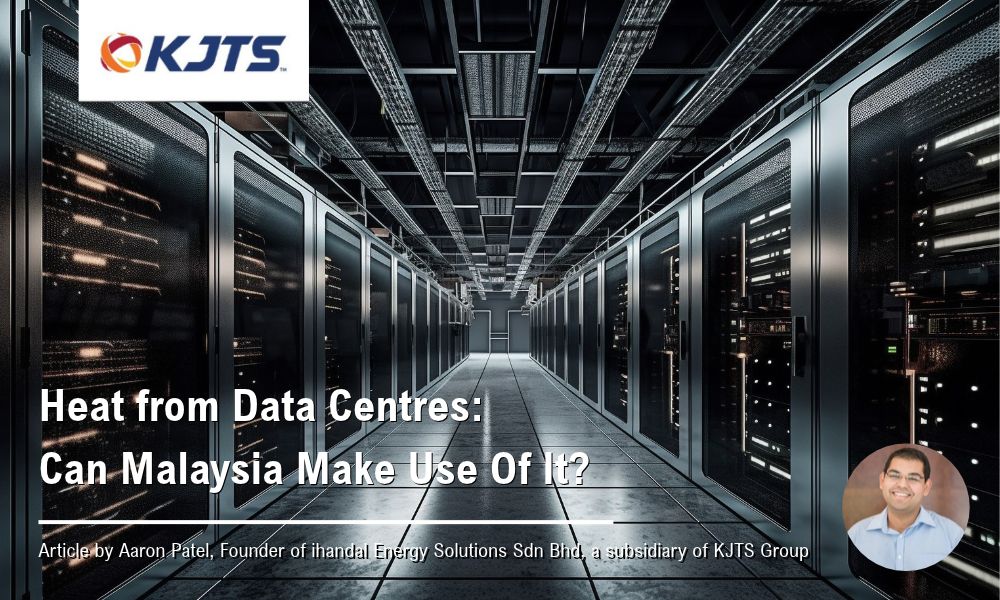
KJTS Group is sharing another LinkedIn article in our Thought Leadership series. In this latest article, Aaron Patel, founder of iHandal Energy Solutions Sdn Bhd, a subsidiary of KJTS Group, examines the potential of data centre heat recovery in Malaysia. He explores where it could work, the technical and commercial challenges involved, and where the numbers may not add up.
It highlights the technical and commercial considerations involved in heat recovery. Conventional air-cooled data centres typically generate low-grade heat, which may not meet the temperature requirements of industrial processes without additional heating. The article also examines how Malaysia’s warm water supply conditions can affect the potential energy savings.
The article covers potential applications in commercial laundries and food processing facilities, the use of recovered heat for cooling, the impact of transfer distance and the need to manage different operating schedules. It also highlights the importance of assessing energy consumption, backup requirements and overall project economics before proceeding with an investment.
Through these practical considerations, Aaron shares insights into where data centre heat recovery could be viable in Malaysia and why early planning, feasibility assessments and pilot projects are important in establishing its technical, financial and environmental benefits.
*The article was first published on the KJTS Group LinkedIn page on 20 October 2026.
Most of the talk about Malaysia’s data centre boom, from Johor to Cyberjaya, has been about power and water. Fair enough. Both are under real pressure. But I keep coming back to a different question, and I don’t think we’re asking it enough. What happens to all the heat?
Every one of those buildings spends a lot of money pulling heat away from its servers and pushing it out into the air. A few kilometres away, a commercial or industrial facility may well be burning gas to make hot water for its guests or its processes. On paper, they should be talking to each other.
In Europe, recovered data centre heat often goes into district heating to keep homes warm through winter. We have no use for that here. If heat recovery is going to work in Malaysia, it has to suit our climate and the industries we actually have.
At iHandal, we’ve spent more than 17 years recovering waste heat and supplying hot water to hotels and factories in 15 countries. Most of that work comes down to working out where a business needs heat and whether it can get it more cheaply. I think data centre heat deserves a serious look. I’m also a little wary of the hype around it, so this piece covers the catches as much as the opportunity.
First, is the heat hot enough?
Probably not, at least not straight out of most data centres today.
A conventional air-cooled facility tends to give off heat at around 30 to 40°C. A laundry, or a food plant washing down its lines, usually wants water a good deal hotter than that, often 60°C or more.
We also have a local problem. In colder countries, the water comes out of the mains cold, so even low-grade heat can do useful pre-heating. Our tap water sits at close to 30°C for most of the year. That leaves warm data centre water with much less to do on its own.
So in most cases you’d need a heat pump to lift the temperature. That can work well. But a heat pump runs on electricity, and the bigger the lift, the more it uses, so that cost has to go into the sums.
For the business taking the heat, the test is simple enough. Once you’ve paid to capture it, pipe it over and boost it, is it still cheaper than what you’re doing now? And once you count the extra electricity, does it actually cut emissions? You need a yes to both.
Here’s what that looks like in numbers. A hotel or industrial facility typically needs hot water at anywhere between 60°C and 90°C. A conventional boiler burns fuel for all of that heat at around 80% efficiency, so a fifth of the energy is lost. At typical hot water temperatures, a well-designed heat recovery heat pump such as our HeatFuse® system draws around 75% of the energy it delivers from waste heat, such as a data centre’s, and only 25% from electricity. For the end user, that means up to 75% less energy to pay for. And if that electricity is sourced entirely from renewables, whether through Renewable Energy Certificates (RECs) or a green electricity supply, the carbon saving can reach 100%.
Who might actually use it?
I’d start with businesses that need hot water every day, in fairly steady volumes.
For most of them, recovered heat wouldn’t replace the boiler. It would do part of the work first, so the boiler burns less fuel. That’s a less exciting story than “zero-carbon heat”, but it’s probably the honest one.
Some drying processes could fit too, depending on the temperatures and humidity involved.
An idea that comes up a lot for a country like ours is turning waste heat into cooling. Absorption chillers can do this, but they generally need heat at 80°C or more, well above what an air-cooled data centre gives off. Using a heat pump to boost low-grade heat just to drive an absorption chiller rarely beats running an ordinary electric chiller.
Then there’s distance, which can kill a project on its own. A heat user next door is one thing. A heat user five kilometres away is another. That means five kilometres of insulated pipe, pumps to push the water through it, and heat lost along the way. The numbers can turn against you very quickly.
If I were starting on this, I’d map the businesses close by that need heat consistently. Then I’d check how well their demand lines up with what the data centre can actually supply.
What happens at 3am on a Sunday?
A data centre never switches off. A factory does. It might run a single shift, or close for a week over Chinese New Year or Hari Raya.
The servers still need cooling while the factory is closed. So the data centre can’t rely on its neighbour to take the heat. It has to be able to get rid of it some other way.
The factory has the opposite worry. If it comes to depend on recovered heat and the supply stops, it needs a backup ready.
I don’t see either issue as a deal-breaker, but both need to be settled at the design stage. They affect what equipment each side needs, what it costs to run and who is responsible when something goes wrong.
One assumption I’d push back on is that heat recovery lets a data centre install a smaller cooling plant. I don’t think it does. The operator still needs full cooling capacity for the days when nobody is taking the heat. Keeping the servers running will always come first for them, and any link to an outside customer has to be designed around that.
The simplest answer is to keep the two systems physically separate, so each can run on its own when it has to and share heat when it can. If the customer stops taking heat, the data centre sends it to its own cooling plant, as it would have done anyway, and the customer’s boiler picks up the load. We’ve done this for customers whose heating and cooling loads rarely line up, bridging the gap with thermal storage and smart controls. That’s what our HeatFuse® system is designed for: sustainability without compromise.
Plan for it before the concrete is poured
You can add a heat connection to a finished data centre, but it’s harder and costs more than designing it in from the start.
I’d like to see developers and industrial park planners asking the questions much earlier. Who will be operating next door, and how much heat will they need, at what temperature? Has anyone left space for the pipework?
The answers would quickly show where a proper feasibility study is worth paying for.
Liquid cooling could change things. It tends to give off heat at higher temperatures than air cooling, often 45°C or more, which makes that heat more useful. Even so, I’d want to see real temperatures from a working system before getting too excited.
Today, Malaysia’s sustainable data centre guidelines for investment incentives judge facilities mainly on power usage effectiveness (PUE), which gives no credit for heat that gets reused. Germany has gone further: under its Energy Efficiency Act, new data centres must now reuse a share of their waste heat, starting at 10% and rising to 20% for those opening after mid-2028. If government support comes in, I’d hope it’s measured on the useful heat actually delivered and the fuel it replaces, after taking off the electricity used to recover it. Otherwise, we may end up funding projects that look green on paper and save very little.
Someone needs to try it
What I’d really like to see is one proper pilot in Malaysia: a data centre paired with a nearby business that needs heat every day.
That would give us real installation costs and operating data instead of estimates. We’d see how the arrangement copes when demand drops, how much backup it needs and whether the savings justify the investment.
I suspect plenty of sites won’t work. The heat will be too cool, or the nearest customer too far away. That’s fine. But where the conditions look promising, it seems a waste not to at least get the developer and the neighbours talking before the plans are locked in.