




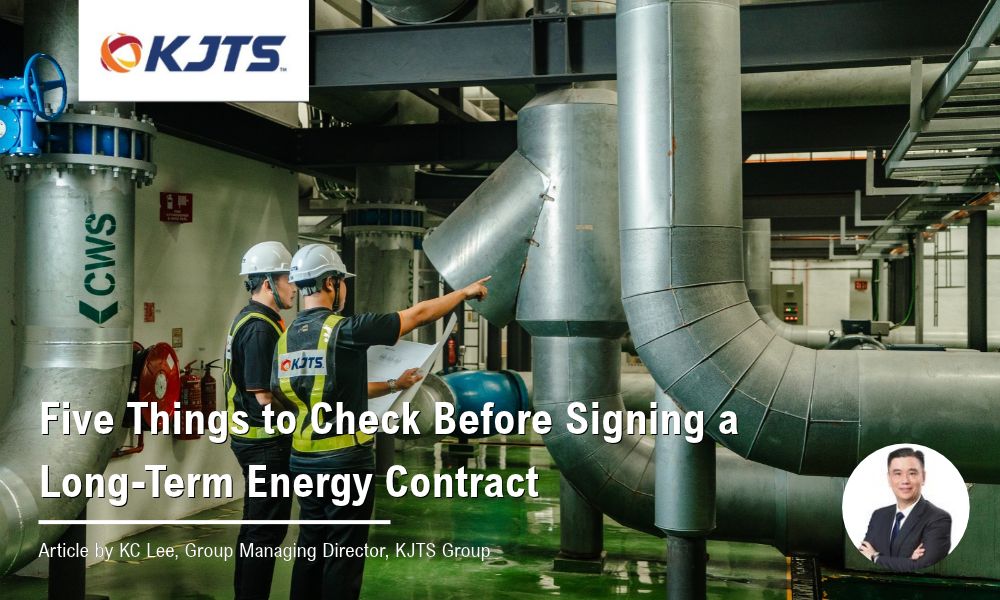
KJTS Group is sharing a LinkedIn article by our Group Managing Director, KC Lee. The article focuses on five practical considerations businesses should evaluate before signing a 10 or 20 year energy contract.
It highlights the importance of looking beyond the initial savings. Over the life of a long-term agreement, business operations, energy requirements and equipment needs can change.
The article covers five key areas. Equipment responsibility, performance measurement, savings calculations, changing business requirements and contract expiry. These considerations help businesses understand how an energy arrangement should work throughout its full term.
Drawing on 24 years of experience in the energy business, KC shares practical perspectives on evaluating long-term energy arrangements and the considerations that should be addressed before signing
*The article was first published on KC Lee’s LinkedIn profile on 6 October 2026.
I have been in this business for 24 years. In 2003, I was put in charge of operations and maintenance at a shopping mall in the Klang Valley, which was our first energy performance contract. One thing I have learnt since then is that no two businesses operate exactly the same way. More importantly, the way a business operates today may be very different five or ten years from now.
With Malaysia placing greater emphasis on energy efficiency, and businesses looking for better ways to manage their energy consumption and costs, we are going to see more companies considering longer-term energy solutions. That is a good thing, as there is a lot businesses can do to improve energy efficiency without taking on the full cost and responsibility themselves.
But if you are signing an agreement for 10 or 20 years, you need to look beyond the savings offered at the start.
A lot can happen over that period. Your business may expand, operating hours may increase, the building may need more cooling, and equipment will eventually need to be repaired or replaced.
So before signing, take the time to understand how the arrangement will work over the full contract period. Here are five areas I believe every business should consider.
1. Be clear about who is responsible for the equipment
Start with the basics. Who owns the equipment, who maintains it, and who pays when something needs to be repaired or replaced?
When everything is new and running well, these questions may not seem urgent. Five or ten years down the road, they become much more important.
Understand what your service fee covers and what you may have to pay for separately. If a major component needs replacing, agree who makes the decision and how the work will be managed if it affects your operations.
You do not want to be having this discussion for the first time when something breaks down.
In most of our own contracts, we upgrade or build the plant, own and operate it for the contract period, and then hand it over to the building owner. Because we are responsible for that equipment for the full term, looking after it properly is in our own interest. Where some existing equipment stays in place alongside the new, agree early who looks after which, and who pays for repairs to the older items.
2. Make sure everyone understands what good performance means
Performance should not be open to interpretation. With a cooling system, for example, there should be a clear understanding of what the system is expected to deliver, how efficiently it should operate, how quickly the provider must respond when there is a problem, and what happens if those expectations are not met.
The measure we rely on most in our contracts is how much electricity the plant needs for each ton of cooling it produces. It is a simple number, and the customer sees it in a report every month.
This works both ways: as the customer, you may also need to provide access to equipment, operating information or support from your facility team.
Both sides should know what they are responsible for from day one.
3. Understand where the savings come from
Savings are the number most businesses look at first. If someone tells you that you can save a certain amount on your energy costs, ask how that figure was calculated:
• What is the baseline?
• How will the savings be measured?
• What happens if your operating hours increase, occupancy changes or production goes up?
You should also know whether the savings presented to you are projected or guaranteed, because there is a difference. If there is a guarantee, understand what happens if it is not achieved.
The same applies to what you are paying. Ask which charges are fixed, which depend on usage, and whether either can change during the contract period.
Our contracts usually have a fixed monthly charge that covers the investment in the plant and its maintenance, adjusted each year on an agreed basis, and a usage charge that is linked to the electricity tariff. When the tariff changes, the usage charge changes with it. That is fair to both sides, but you should see the formula before you sign.
A small difference may not look like much in the first year, but over 10 or 20 years it adds up.
4. Think about where your business is going
Your business will change. A hotel may add more rooms, a factory may introduce another production line, or a commercial building may get new tenants or extend its operating hours.
You cannot plan for every possible scenario, and nobody expects you to, but the contract should give you a practical way to deal with these changes:
• If you need more capacity, can the system accommodate it, and how will that affect your charges?
• What if your requirements decrease?
Every plant is designed for a maximum load. If your demand grows beyond it, that is a change to the contract, so it is better to agree at the start how such a change will be handled and priced.
These are much easier conversations to have before signing than ten years into an agreement.
5. Know what happens when the contract ends
When you are signing a 20-year agreement, the end probably feels very far away. Ask anyway.
• Who owns the equipment at the end of the contract, and if it transfers to you, what condition should it be in?
• What happens to the maintenance records and operating information?
We have the plant inspected three months before a contract ends, and any defects found are put right before handover.
You should also understand what happens if the agreement needs to end earlier than expected. Nobody enters a long-term partnership planning for that, but both sides should still know what the process and costs would be.
Going in with your eyes open
Malaysia’s energy market is changing, and more businesses will be looking at how much energy they use and where they can save.
There are good solutions available, and long-term energy contracts can help businesses make improvements without having to manage everything themselves.
Before you sign, ask how the savings are calculated, what each party is responsible for, what happens when your business changes, and whether the arrangement still makes sense over the longer term.
When these arrangements are set up well, customers stay. One of our shopping mall customers signed with us for 15 years, and when that contract ended, renewed for another 20. Relationships that span decades create opportunities that go beyond operational reliability. Technology keeps evolving, and as cooling is our core business, we are constantly evaluating new solutions, improving plant performance, and identifying innovations worth adopting across our portfolio. For most building owners, the cooling plant is one of many responsibilities, and it may only be reviewed every five to ten years.
10 or 20 years is a long time, and a good agreement should be able to grow and change with your business.